
HOKA vs Barefoot Shoes: What's the Difference?
Honest comparison · By Delaney, Muscle Activation Techniques & gait specialist
HOKA vs. Barefoot Shoes:
What's the Difference?
HOKA makes some of the most cushioned shoes on the market. Minnemals makes some of the least. Here's what that actually means for your feet, your posture, and your long-term movement health.

More cushioning isn't always more protection. Here's why.
HOKA is engineered to absorb impact for you. Minnemals is engineered to let your foot absorb impact itself, and get stronger in the process. Neither is objectively "better." But if you care about foot strength, natural posture, and long-term mobility, they point in very different directions.
Two completely different philosophies
HOKA became one of the fastest-growing shoe brands in the world by solving a real problem: running and walking hurt for a lot of people, and thick cushioning reduces impact felt. That's not wrong. But there's a question worth asking: are you solving the problem, or masking it?
The HOKA Bondi 9, their flagship cushioned shoe, has a heel stack of 41mm. That's roughly 1.6 inches of foam between your heel and the ground. The Clifton 10 comes in at 42mm. Most of their lineup sits between 30–43mm and carries a heel-to-toe drop of 5–9mm, meaning your heel sits meaningfully higher than your toe.
Minnemals works from the opposite principle. The Stimulus V2 has a thin, flexible sole. Your foot is close to the ground on purpose. The zero-drop design means heel and forefoot sit at the same height. The wide toe box lets your toes splay naturally. Nothing is correcting your gait or absorbing your load. Your foot is doing that work.
"For years I watched clients come in with foot pain, knee pain, hip issues, and trace it back to the same thing: footwear that had been doing their feet's job for them causing underlying foot weakness."
— Delaney, gait specialist & Minnemals founder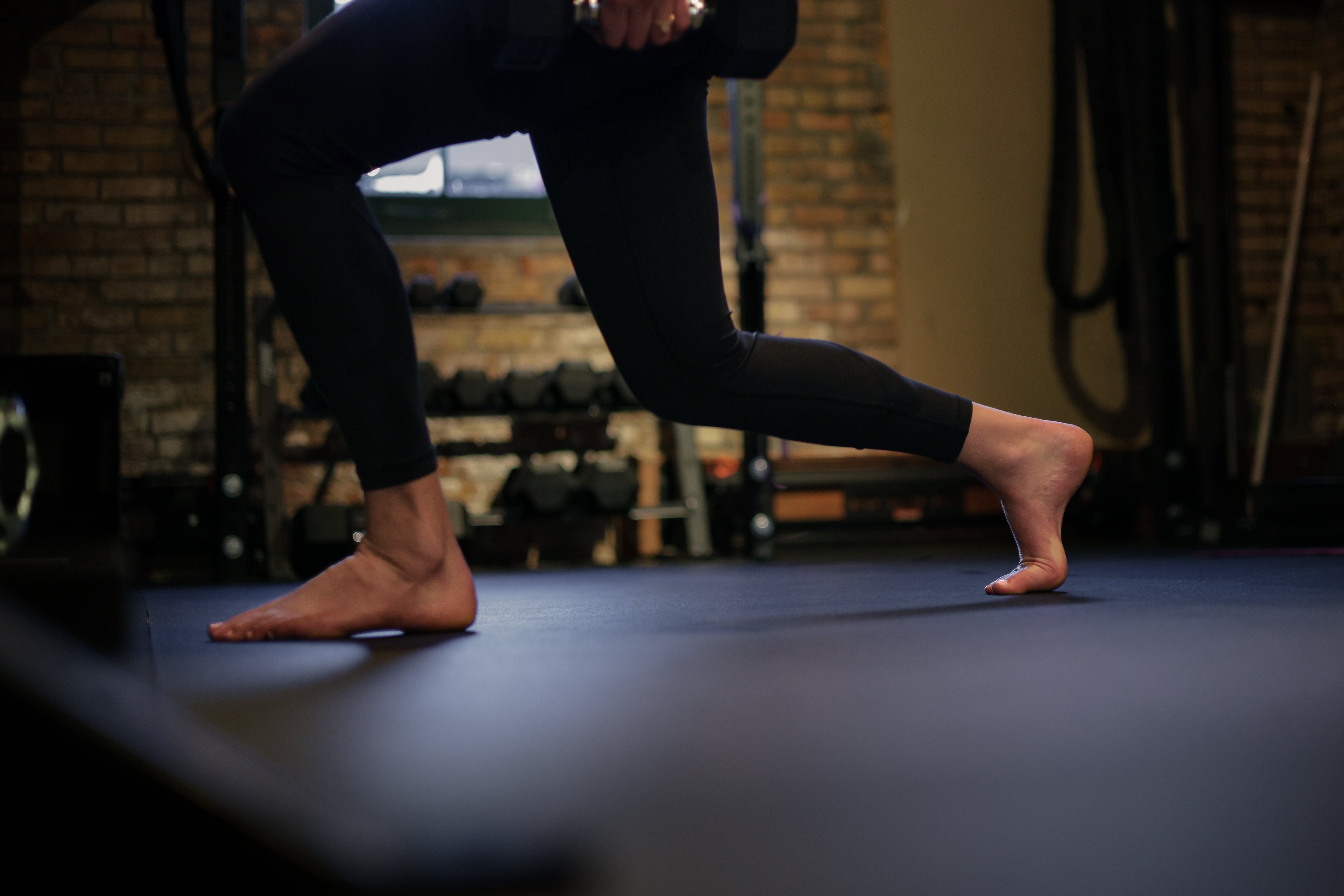
Maximalist: 30–43mm stack, 5–9mm heel drop

Minnemals: thin flexible sole, 0mm heel drop
What all that cushioning actually does to your feet
Cushioning isn't inherently bad. But when it's thick enough to eliminate ground feel entirely, a few things start to happen over time.
Your intrinsic foot muscles stop firing. The 26 bones, 33 joints, and over 100 muscles and tendons in your foot are designed to actively engage with each step. When thick foam absorbs that load, those muscles become passengers. Use it or lose it, and most people are losing it, one cushioned step at a time.
Your heel-strike pattern is reinforced. HOKA's elevated heel encourages you to land heel-first. This loads your joints differently than a midfoot or forefoot strike, and sends impact force up through the knee and hip rather than dispersing it through the foot's natural spring mechanism.
Proprioception decreases. Your feet have more nerve endings per square inch than almost anywhere on your body. They're sending constant information to your brain about position, balance, and force. A thick midsole filters much of that signal. Less information reaching the brain means subtly worse movement quality and over time, worse balance.
What the research shows
- A 2022 study in Nature found that foot muscle strength is significantly greater in habitual barefoot walkers than in shoe wearers.
- Research from Harvard's Skeletal Biology Lab showed that barefoot and minimally shod runners generate less impact force than heavily shod runners.
- A 2021 review in JOSPT found that minimalist footwear interventions increased foot muscle cross-sectional area and arch stiffness over 8–26 weeks.
Head-to-head comparison
| HOKA (e.g. Bondi 9 / Clifton 10) |
Minnemals Stimulus V2 |
|
|---|---|---|
| Heel stack height | 41–43mm Maximalist |
Thin flexible sole Minimal |
| Heel-to-toe drop | 5–9mm Elevated heel |
0mm Zero drop |
| Toe box shape | Tapered at the toe | Wide, foot-shaped Toes splay freely |
| Ground feel | Heavily muted | High proprioception |
| Foot muscle activation | Low — foam absorbs load | High — foot does the work |
| Posture effect | Anterior pelvic tilt encouraged | Neutral alignment |
| Best for | Long road runs, recovery, high mileage | Everyday strength, lifting, walking, all-day wear |
| Price | $140–$175 | $125 |
To be fair: when HOKA makes sense
This isn't a takedown. HOKA built a dominant brand by solving a genuine need, and there are situations where maximalist cushioning is the right tool.
If you're running 50+ miles a week and your body needs impact protection to survive training volume, a heavily cushioned shoe can help you recover between sessions. If you have an acute injury and have been told by a physio to reduce load temporarily, cushioning can provide relief. If you're a concrete-floor worker logging 10+ hours on hard surfaces, there's a case for more underfoot protection.
The problem is that most HOKA customers aren't in those categories. Most are people who experience foot or knee pain and are hoping more cushioning will fix it when the cushioning may be part of what's weakening the foundation in the first place.
"The shoe industry has sold us the idea that our feet need to be wrapped in foam. But your feet are extraordinarily capable structures when you let them do their job."
— Delaney, Minnemals founderWho each shoe is actually for
HOKA might be right for you if...
- You're running very high mileage (50+ mi/week)
- You have an acute injury and need temporary load reduction
- Your physio has specifically prescribed maximalist cushioning
- You work 10+ hour shifts on concrete or hard floors
Minnemals might be right for you if...
- You have chronic foot, knee, or hip pain without a clear diagnosis
- You lift, do CrossFit, or care about stability during training
- You want to build foot and ankle strength long-term
- You value ground feel and proprioception
- You're interested in what your body can do naturally, not just mask everything with a shoe
What to expect if you switch from HOKA
This is the part most comparison articles skip. Switching from maximalist to minimalist shoes is a genuine transition. Your feet have likely been getting assistance for years. Like any muscle that's been underworked, they'll need time to adapt.
Week 1–2: You may feel your calves and arches working harder than usual. That's normal, it's the correct muscles activating. Don't do too much too fast.
Week 3–4: Most people notice they feel more grounded and stable. Balance tends to improve noticeably around this period.
Month 2–3: Foot strength and arch engagement typically become noticeable. Many customers report that going back to cushioned shoes feels strange and disconnected.
The transition pace depends on how much time you've spent in conventional shoes and how strong your feet currently are. Start by wearing Minnemals for 1–2 hours a day and gradually increase from there. If you're used to HOKA for long runs, those aren't the place to start — wear your Minnemals for walking and daily activity first.
Minnemals transition tips
- Start with daily wear : walking, errands, the gym. Start with a short time period or distance.
- Your feet may feel more tired than usual for the first 1–2 weeks. This is them working, not a warning sign.
- Pair the transition with simple foot exercises.
- Don't try to run in barefoot shoes or walk 5 miles on day one, especially if you've been in maximalist shoes for years
The bottom line
HOKA makes a technically impressive product. Their cushioning is genuine, their materials have improved significantly, and their market success is well-earned. If impact protection and long-distance comfort are your primary needs, they deserve serious consideration.
But if you're looking at shoes through the lens of long-term foot health, movement quality, and building a body that works well for decades, the philosophy behind Minnemals points in a more interesting direction. Letting your feet do their job. Building the foundation rather than outsourcing it.
There's a reason Minnemals is recommended by physical therapists, movement professionals, and gait specialists. Not because it cushions more, but because it asks more of your body and over time, your body rises to meet that.
Ready to feel the difference?
The Stimulus V2 is built by a gait specialist for people who want to move better, not just feel cushioned. Free shipping on orders over $50.
Explore the Stimulus V2


Doctor of Physical Therapy
Nicki Carlson

